
Elective pay allows certain organizations and taxpayers to receive the financial benefit of eligible clean energy and manufacturing tax credits even when they cannot use those credits to offset a federal income tax liability.
The provision was created under the Inflation Reduction Act of 2022 and related provisions of the CHIPS Act of 2022. By 2026, the IRS has an established process for entities seeking elective payment, including online pre-filing registration through Energy Credits Online (ECO).
The current rules are important because elective pay isn’t available to every business or for every tax credit. Eligibility depends on the type of taxpayer, the qualifying property or activity, and the specific credit involved.
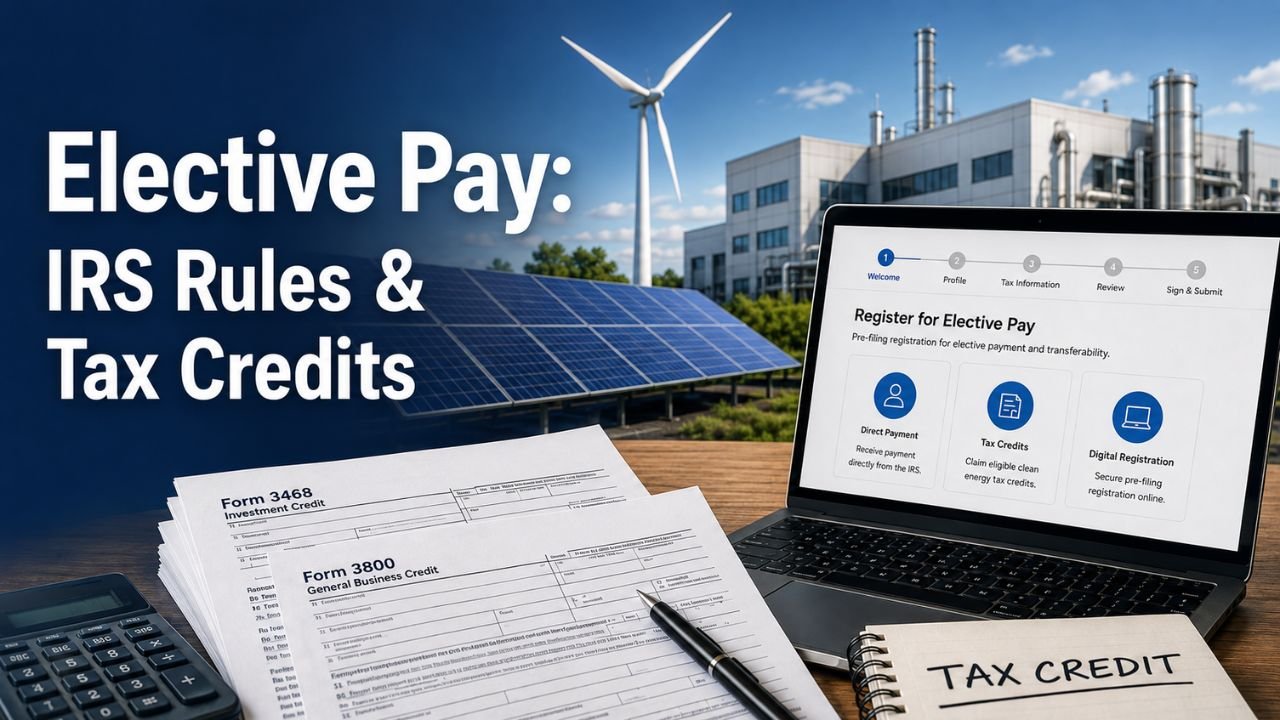
Table of Contents
What Is Elective Pay?
Elective pay, also called direct pay, allows an eligible entity to treat the amount of a qualifying tax credit as a payment of federal income tax.
When the entity has no federal income tax liability, the full amount of an eligible credit can generally result in a refund. If the entity does have a federal income tax liability, the credit first offsets that liability, with any remaining amount generally refunded.
This makes elective pay particularly relevant to organizations such as governments and tax-exempt entities that may make qualifying clean energy investments but normally cannot use a traditional business tax credit against income tax.
Elective pay is therefore different from simply claiming a tax credit to reduce an existing tax bill.
Who Is Eligible for Elective Pay?
The IRS identifies specific categories of applicable entities that can use elective pay.
These include:
- Tax-exempt organizations described under applicable sections of the Internal Revenue Code
- States and political subdivisions, including cities and counties
- Indian tribal governments and qualifying tribal entities
- U.S. territories and their political subdivisions
- Certain agencies and instrumentalities of state, local, tribal, and territorial governments
- Rural electric cooperatives
- Alaska Native Corporations
- The Tennessee Valley Authority
The IRS also has special rules allowing certain taxpayers that aren’t normally applicable entities to make an elective-payment election for Sections 45Q, 45V and 45X. Partnerships and S corporations have additional rules for these credits.
Being a business or having a clean energy project doesn’t automatically make an organization eligible. The entity must satisfy the requirements applicable to the particular credit.
Which Tax Credits Qualify for Elective Pay?
The IRS currently identifies a range of credits that can qualify for elective pay when the applicable requirements are met.
These include credits associated with energy investment, electricity production, clean vehicles, hydrogen, advanced manufacturing, carbon sequestration, and other qualifying activities.
The applicable credits listed by the IRS include:
- Section 48 Energy Credit
- Section 48E Clean Electricity Investment Credit
- Section 45 Renewable Electricity Production Credit
- Section 45Y Clean Electricity Production Credit
- Section 45W Commercial Clean Vehicle Credit
- Section 45U Zero-Emission Nuclear Power Production Credit
- Section 45X Advanced Manufacturing Production Credit
- Section 45V Clean Hydrogen Production Credit
- Section 45Z Clean Fuel Production Credit
- Section 45Q Carbon Oxide Sequestration Credit
- Section 30C Alternative Fuel Vehicle Refueling Property Credit
- Section 48C Qualifying Advanced Energy Project Credit
The underlying requirements for each credit still apply. Receiving permission to register for elective pay doesn’t mean the IRS has already determined that a project qualifies for the credit.
How Elective Pay Works With the IRS Tax Return
Elective pay doesn’t replace the normal tax-credit rules.
The qualifying entity must first earn an eligible credit by satisfying the requirements associated with the investment, property or production activity. It then completes the required pre-filing registration and receives the applicable registration number.
When the entity later files its annual return, it makes the elective-payment election using the applicable tax forms and registration number.
For example, Form 3800 is used for the General Business Credit in situations where it applies, while individual credits may require additional source-credit forms. The specific forms depend on the credit and the taxpayer’s filing requirements.
The IRS emphasizes that receiving a registration number does not guarantee that the taxpayer qualifies for the credit or that an elective payment will be made. The taxpayer must still establish eligibility and make a valid, timely election on the tax return.
IRS Pre-Filing Registration for Elective Pay
Pre-filing registration is a required part of the elective-pay process.
The IRS now provides the registration process through Energy Credits Online (ECO). An authorized representative uses the system to provide information about the entity, the applicable credits, and the credit properties associated with those credits.
The IRS reviews the submitted information and issues a registration number for each applicable credit property when sufficient verifiable information has been provided.
A registration number is important because the IRS requires it on the annual return when the entity makes an elective-payment election. Without the required registration number, the elective-payment election isn’t valid.
Registration timing
The IRS recommends allowing sufficient time for review. Registration should generally be completed:
- After the investment property or production facility has been placed in service
- No earlier than the beginning of the tax period in which the credit is earned
- At least 120 days before the due date of the return, including extensions
The 120-day period gives the IRS time to review the submission and gives the taxpayer time to respond if additional information is requested.
The IRS anticipates opening registration for each new tax year during the first calendar quarter of that year.
Registration Numbers and Credit Properties
A registration number is associated with the applicable credit property reported during the registration process.
In general, a separate registration number is required for each applicable credit property that contributes to the credit for which the entity intends to make an elective-payment election. The exact treatment can depend on the rules governing the underlying credit.
Registration numbers are also tax-year specific. If an eligible credit can be claimed over multiple years, the registration generally must be renewed for each tax year in which the entity intends to make an elective-payment election.
This distinction is important because receiving a registration number in one year doesn’t automatically authorize elective pay for subsequent years.
Elective Pay and Credit Transfer Are Different
Elective pay and credit transfer both provide ways to monetize certain tax credits, but they work differently.
Under elective pay, an eligible entity makes an election to receive the value of a qualifying credit as a payment.
Credit transferability allows an eligible taxpayer to transfer certain tax credits to an unrelated buyer in exchange for cash. The buyer and seller agree on the transaction terms and price.
The distinction is especially important for applicable entities. The IRS states that applicable entities cannot use transferability; they use elective pay when they meet the requirements.
A separate registration number used for elective pay also cannot simply be used for a transfer election. The IRS treats the two processes separately.
What a Registration Number Does and Doesn’t Mean
A registration number confirms that the IRS has completed the pre-filing registration process for the applicable credit property based on the information provided. It does not mean the IRS has guaranteed the tax credit.
The taxpayer must still meet the underlying requirements of the credit, provide the required information with the annual return and make a valid elective-payment election. The IRS can also review the taxpayer’s eligibility later, including through an audit.
This is an important distinction when discussing elective pay because pre-filing registration is an administrative requirement, not a final determination that every aspect of a tax-credit claim is correct.
Elective Pay in 2026
The elective-pay system is now an established IRS process rather than a new 2023 initiative.
The IRS’s current 2026 registration page directs eligible entities to Energy Credits Online and requires an authorized representative to provide the entity’s information, obtain registration numbers for applicable credit properties and include those numbers on the annual tax return. The IRS page was last reviewed or updated on July 14, 2026.
The IRS also continues to provide elective-pay and pre-filing registration FAQs, with the elective-pay FAQ page reviewed or updated in March 2026.
For organizations researching elective pay today, current IRS guidance should therefore be used instead of older articles that describe the process specifically as a new 2023 program.
Elective Pay and Form 2290 Are Separate Tax Matters
Elective pay should not be confused with Form 2290, which is used to report and pay the Heavy Highway Vehicle Use Tax for qualifying heavy highway motor vehicles.
The two processes address completely different federal tax requirements. Elective pay concerns certain clean energy and manufacturing tax credits, while Form 2290 concerns the federal heavy highway vehicle use tax.
Businesses that deal with both areas should treat their requirements separately rather than assuming that procedures for one apply to the other.
IRS Resources for Elective Pay
The IRS maintains several resources covering elective pay, credit transferability, and pre-filing registration. The main IRS Elective Pay and Transferability page explains the current framework and registration requirements.
The IRS’s Register for elective payment or transfer of credits page contains the current Energy Credits Online registration process, timing information, and registration-status guidance.
The IRS also maintains separate FAQ pages covering eligibility, applicable credits, registration, and transferability. These resources are particularly useful because the rules can differ by credit and entity type.
FAQs About Elective Pay
Is elective pay still available in 2026?
Yes. The IRS continues to provide elective pay for qualifying entities and eligible tax credits in 2026. The current registration process is available through Energy Credits Online.
How long is an elective-pay registration number valid?
Generally, a registration number is valid only for the taxable year for which it was obtained. A new registration is generally required for subsequent years when the taxpayer continues making an elective-payment election.
What happens if the IRS hasn’t issued a registration number?
The IRS recommends contacting it through Energy Credits Online secure messaging when the extended return due date is 60 days or less away without a registration number, or when a registration package has been submitted for more than 90 days without a status change during the preceding 30 days.
Does an organization need an EIN for registration?
Yes. The IRS requires the registering entity to use its own EIN. A related or affiliated entity’s EIN cannot be used in its place.
Where is elective-pay registration completed?
The IRS uses Energy Credits Online (ECO) for the registration process. The entity’s authorized representative must use the IRS system to provide the required information and obtain registration numbers.