

File Heavy Vehicle Use Tax Return (HVUT) Online
File and pay your Heavy Vehicle Use Tax (HVUT) online with Form 2290.
Truck2290 makes it easier to prepare your return, submit it electronically, and receive your IRS Schedule 1 after the return is accepted
What Is Heavy Vehicle Use Tax (HVUT)?
The Heavy Vehicle Use Tax (HVUT) is a federal excise tax on certain heavy highway motor vehicles used on public highways in the United States.
Generally, Form 2290 applies to a highway motor vehicle with a taxable gross weight of 55,000 pounds or more. The person whose name the vehicle is registered, or required to be registered, under applicable state, District of Columbia, Canadian, or Mexican law generally files Form 2290.
The IRS uses Form 2290, Heavy Highway Vehicle Use Tax Return, to report and pay this tax.
Who Must File Form 2290?
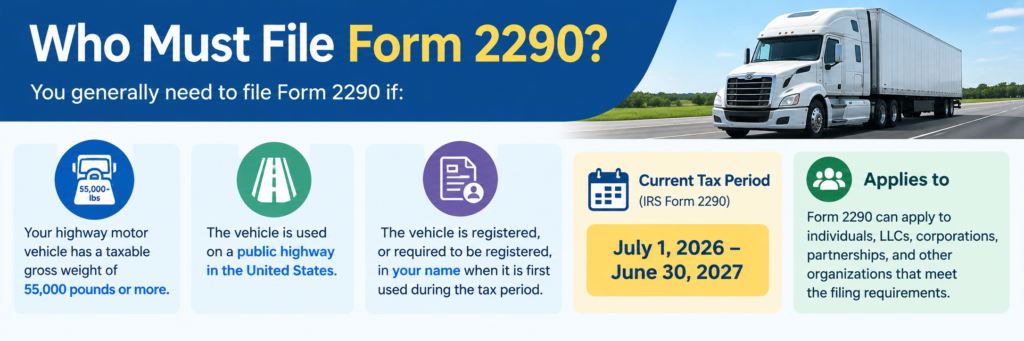
You generally need to file Form 2290 if:
Your highway motor vehicle has a taxable gross weight of 55,000 pounds or more.
- Your highway motor vehicle has a taxable gross weight of 55,000 pounds or more.
- The vehicle is used on a public highway in the United States.
- The vehicle is registered, or required to be registered, in your name when it is first used during the tax period.
The tax period for the current IRS Form 2290 is July 1, 2026, through June 30, 2027.
Form 2290 can apply to individuals, LLCs, corporations, partnerships, and other organizations that meet the filing requirements.
Which Vehicles Are Subject to HVUT?
Common examples of highway motor vehicles that may be subject to Form 2290 include:
Groups exempted from heavy highway use tax form 2290 include:
- Trucks
- Truck tractors
- Buses
- Other self-propelled vehicles designed to carry a load over public highways
The taxable gross weight is used to determine the applicable tax category. For vehicles other than buses, it generally includes the vehicle’s unloaded weight, the unloaded weight of trailers or semitrailers customarily used with it, and the maximum load customarily carried.
Who Is Exempt From HVUT?
Certain highway motor vehicle uses are exempt from HVUT when the IRS requirements are met.
These include vehicles used and actually operated by:
- The federal government
- The District of Columbia
- A state or local government
- The American National Red Cross
- A nonprofit volunteer fire department, ambulance association, or rescue squad
- An Indian tribal government when the vehicle’s use involves an essential tribal government function
- Certain qualifying mass transportation authorities
Qualified blood collector vehicles and certain specially designed mobile machinery may also be exempt from the tax when they meet IRS requirements.
Some vehicles are also not considered highway motor vehicles for HVUT purposes. This can include certain specially designed mobile machinery used for nontransportation functions and vehicles specially designed for off-highway transportation.
What About Low-Mileage Vehicles?
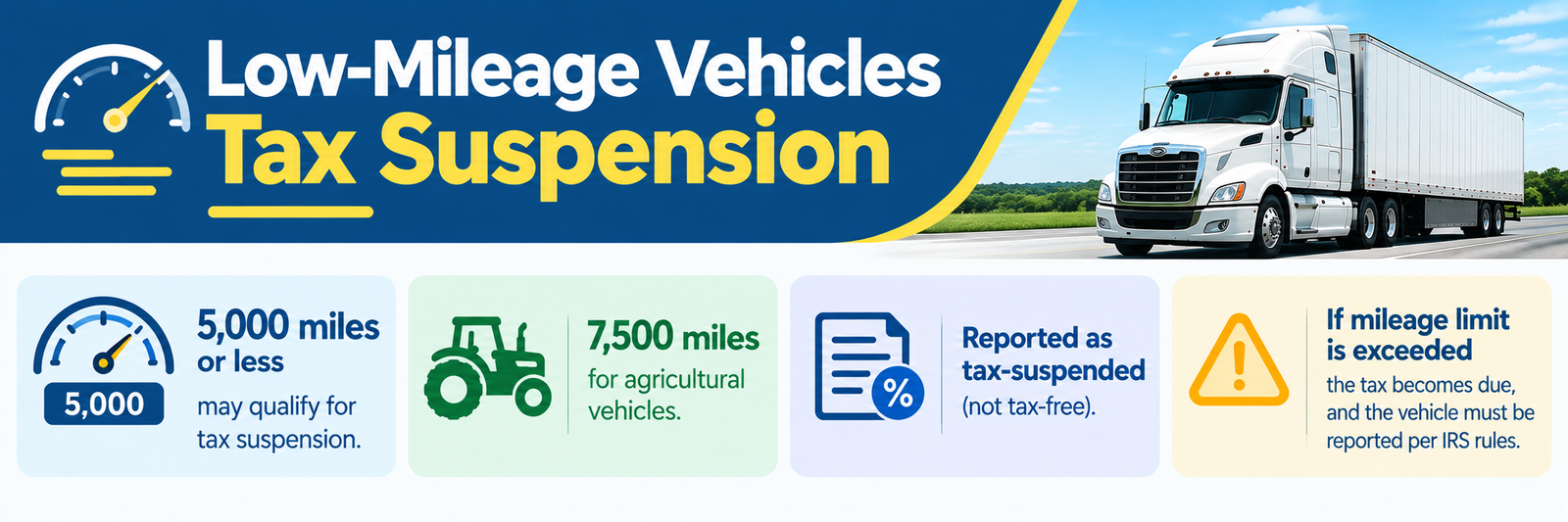
A vehicle expected to be used 5,000 miles or less during the tax period may qualify for suspension of the tax. The limit is 7,500 miles for agricultural vehicles.
These vehicles are generally reported as tax-suspended vehicles rather than treated as simply tax-free vehicles. If a suspended vehicle later exceeds the applicable mileage limit, the tax becomes due, and the vehicle must be reported according to IRS rules.
How Much is the Form 2290 Tax?
The amount of HVUT depends on the vehicle’s taxable gross weight and whether it qualifies as a logging vehicle.
For the 2026–2027 tax period, the annual tax for vehicles used during July starts at $100 for a taxable gross weight of 55,000 pounds and increases by $22 for each additional 1,000-pound category, reaching $550 for vehicles over 75,000 pounds. Logging vehicles generally have a reduced rate of 75% of the regular tax.
| Taxable gross weight | Annual HVUT |
| 55,000 lbs | $100 |
| 55,001–56,000 lbs | $122 |
| 56,001–57,000 lbs | $144 |
| 57,001–58,000 lbs | $166 |
| 58,001–59,000 lbs | $188 |
| 59,001–60,000 lbs | $210 |
| 60,001–61,000 lbs | $232 |
| 61,001–62,000 lbs | $254 |
| 62,001–63,000 lbs | $276 |
| 63,001–64,000 lbs | $298 |
| 64,001–65,000 lbs | $320 |
| 65,001–66,000 lbs | $342 |
| 66,001–67,000 lbs | $364 |
| 67,001–68,000 lbs | $386 |
| 68,001–69,000 lbs | $408 |
| 69,001–70,000 lbs | $430 |
| 70,001–71,000 lbs | $452 |
| 71,001–72,000 lbs | $474 |
| 72,001–73,000 lbs | $496 |
| 73,001–74,000 lbs | $518 |
| 74,001–75,000 lbs | $540 |
| Over 75,000 lbs | $550 |
Vehicles first used after July generally have a partial-period tax based on the month of first use.
How Do I Pay Heavy Vehicle Use Tax?
The IRS provides four payment methods for Form 2290:
- Electronic Funds Withdrawal (EFW): Authorize a direct debit from your bank account when filing electronically.
- EFTPS: Use the Electronic Federal Tax Payment System to make the payment.
- Credit or debit card: Pay the tax by card through an IRS-approved payment processor. A convenience fee may apply.
- Check or money order: Mail the payment with Form 2290-V when using the paper-filing payment method.
The IRS requires the tax to be paid in full with the Form 2290 return
How Do I File Form 2290 Online?
Electronic Funds Withdrawal (EFW): Authorize a direct debit from your bank account when filing electronically.
EFTPS: Use the Electronic Federal Tax Payment System to make the payment.
Credit or debit card: Pay the tax by card through an IRS-approved payment processor. A convenience fee may apply
Check or money order: Mail the payment with Form 2290-V when using the paper-filing payment method.
The IRS requires the tax to be paid in full with the Form 2290 return.
How Do I File Form 2290 Online?
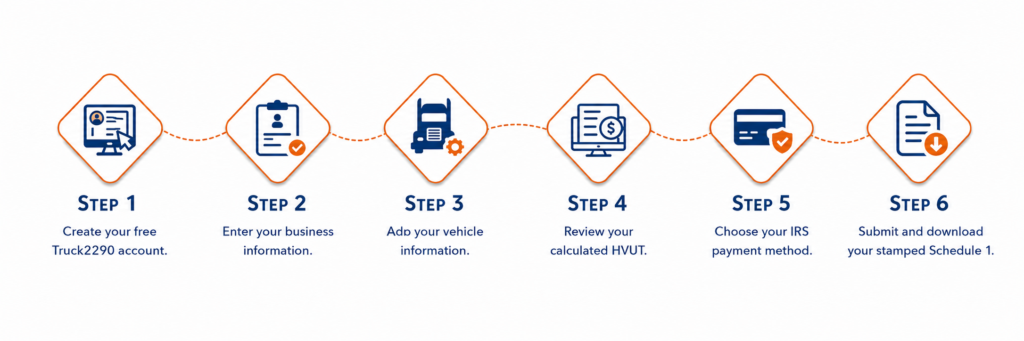
You can file Form 2290 electronically through an IRS-authorized e-file provider.
To prepare your return, you generally need:
1.Employer Identification Number (EIN)
2.Vehicle Identification Number (VIN) for each vehicle
3.Taxable gross weight of each vehicle
4.Month of first use
5.Payment information, if tax is due
The IRS requires electronic filing for a return reporting and paying tax on 25 or more vehicles during the tax period. The IRS also encourages electronic filing for other filers because it can speed up processing.
Once the IRS accepts an electronically filed return, a stamped Schedule 1 can be available within minutes.
What Is Form 2290 Schedule 1?
Schedule 1 (Form 2290) lists the heavy highway vehicles reported on your return by VIN and vehicle category.
After the IRS accepts your return, the stamped Schedule 1 serves as proof of payment for vehicle registration when required.
Truck owners often need a copy of Schedule 1 when completing state vehicle registration requirements.
When Is Form 2290 Due?
The Form 2290 deadline depends on the month the vehicle is first used on a public highway during the tax period.
Generally, you must file Form 2290 and pay the tax by the last day of the month following the month in which the vehicle is first used. If the due date falls on a Saturday, Sunday, or legal holiday, the deadline moves to the next business day.
For example:
| Month of first use | Filing and payment deadline |
| July 2026 | August 31, 2026 |
| August 2026 | September 30, 2026 |
| September 2026 | November 2, 2026 |
| October 2026 | November 30, 2026 |
| November 2026 | December 31, 2026 |
| December 2026 | February 1, 2027 |
The deadline is based on the vehicle’s month of first use, not simply its registration renewal date.
What Happens If Form 2290 Is Filed Late?
Late filing or late payment can result in IRS penalties and interest.
If you receive a penalty and believe you had reasonable cause for filing or paying late, the IRS provides procedures for requesting penalty relief.
Because penalty and interest calculations can depend on the circumstances, avoid publishing a fixed interest percentage on this page unless it has been verified against the current IRS guidance.
File Heavy Vehicle Use Tax (HVUT) Online
Need to file Form 2290 for your heavy vehicle?
Truck2290 lets you prepare and electronically file your HVUT return online. After the IRS accepts your return, you can receive your stamped Schedule 1 for your records and applicable vehicle registration requirements.