
For owners and operators of qualifying heavy highway vehicles, Heavy Vehicle Registration Renewal and Form 2290 are closely connected. The connection comes from the IRS requirement to use the stamped Schedule 1 as proof of payment when registering a taxable heavy vehicle with a state, unless a specific exemption applies.
However, one important point is often misunderstood: Heavy Vehicle Registration Renewal does not determine when Form 2290 is due. The IRS states that the Form 2290 filing deadline is based on the month the vehicle is first used on a public highway during the tax period, not on the vehicle’s registration or renewal date.
For the 2026–2027 tax period, Form 2290 applies to taxable highway motor vehicles registered, or required to be registered, in the taxpayer’s name and having a taxable gross weight of 55,000 pounds or more.
Understanding this distinction can help truck owners organize their Form 2290 filing, Schedule 1 records, and Heavy Vehicle Registration Renewal documents without assuming that the registration date changes the federal tax filing deadline.
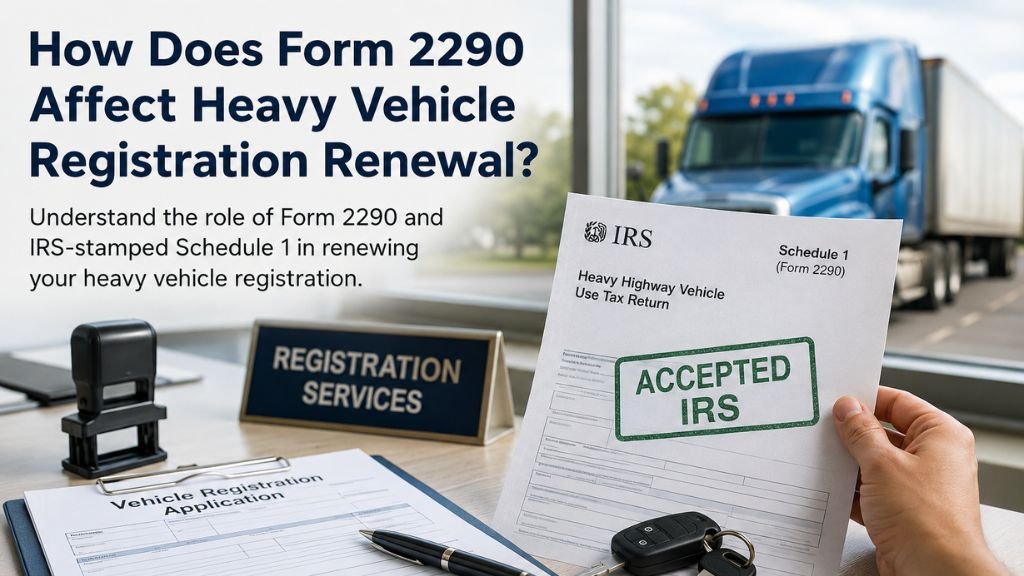
Table of Contents
What Is the Connection Between Form 2290 and HVUT Renewal?
Form 2290 is the federal Heavy Highway Vehicle Use Tax Return. For qualifying vehicles, the IRS requires the return to be filed and the applicable tax to be reported and paid, or the vehicle’s tax suspension to be reported when the IRS rules allow it.
Schedule 1 is particularly important for vehicle registration. The IRS instructions state that Schedule 1 can be used as proof of payment to register vehicles in any state, unless specifically exempted. The IRS returns a stamped copy of Schedule 1 for this purpose.
This creates a practical connection between federal tax filing and Heavy Vehicle Registration Renewal:
- Form 2290 is filed with the IRS.
- The IRS processes the return.
- A stamped Schedule 1 is provided as proof of payment.
- The Schedule 1 can be used when registering the qualifying vehicle with a state.
- State registration procedures determine how that proof is submitted or verified.
The key document is therefore not simply a copy of an unstamped Form 2290. The IRS specifically identifies the stamped Schedule 1 as proof of payment for state registration.
Why Schedule 1 Matters for Registration
The IRS explains that states generally require verification of payment of the Heavy Highway Vehicle Use Tax before registering a taxable vehicle. The stamped Schedule 1 is the standard proof described in the IRS instructions.
For a truck owner preparing for Heavy Vehicle Registration Renewal, keeping the current Schedule 1 available can therefore be an important part of the registration paperwork.
Does Your Registration Renewal Date Determine the Form 2290 Deadline?
No. The IRS makes this distinction explicitly. Form 2290 must generally be filed by the last day of the month following the month in which the vehicle is first used on a public highway during the tax period. The IRS also states that this deadline applies regardless of when the vehicle’s state registration is due.
For example, suppose a qualifying heavy vehicle is first used on a public highway in August. The Form 2290 deadline is based on that August first-use month, not on whether the vehicle’s registration expires in August, September, or another month.
This means a truck owner should treat two dates separately:
Federal Form 2290 deadline: Based on the vehicle’s month of first use on a public highway.
State registration or renewal date: Based on the registration requirements and renewal schedule applicable to the vehicle.
Keeping these dates separate is one of the simplest ways to avoid confusion around Heavy Vehicle Registration Renewal.
The 2026–2027 First-Use Rule
For the 2026–2027 tax period, the IRS provides a month-by-month filing schedule. For instance, a vehicle first used in July 2026 generally has a Form 2290 filing deadline of August 31, 2026. A vehicle first used in August 2026 generally has a deadline of September 30, 2026. If a federal filing deadline falls on a Saturday, Sunday, or legal holiday, the IRS says the deadline moves to the next business day.
The important point is that these deadlines apply independently of the vehicle’s registration renewal date.
What Documents Should You Have for Heavy Vehicle Registration Renewal?
Preparing the correct documents before Heavy Vehicle Registration Renewal can make the process more organized. The exact documentation and submission procedure can vary by state, so vehicle owners should also check their state’s current registration requirements.
For Form 2290-related proof, the IRS identifies the stamped Schedule 1 as the key document.
IRS-Stamped Schedule 1
After Form 2290 is accepted, the IRS provides a stamped Schedule 1. When filing electronically, the IRS instructions explain that an electronic copy of Schedule 1 with an IRS watermark is sent through the e-file provider. The Schedule 1 contains vehicle information, including the VINs reported on the return. The IRS notes that failure to include the full VIN may prevent registration with the state.
Keep Your Form 2290 Records
It is also useful to maintain copies of your filed Form 2290, Schedule 1, and related records with your tax and vehicle documents. If you operate multiple heavy vehicles, organizing Schedule 1 records by tax period and vehicle can make it easier to locate the appropriate document when registration or other administrative requirements arise.
What Happens If Form 2290 and Registration Timing Do Not Match?
It is possible for your Form 2290 deadline and Heavy Vehicle Registration Renewal date to occur at different times.
That does not automatically mean that the federal filing deadline changes. Consider a truck that was first used on a public highway several months before its state registration renewal. The owner may have already needed to file Form 2290 and obtain Schedule 1 well before the registration renewal date.
Conversely, a registration-related requirement may arise while a vehicle owner is dealing with a Form 2290 filing based on a different first-use month.
Do Not Wait for Registration Renewal to File Form 2290
Waiting until registration renewal is approaching can create unnecessary timing problems. The IRS specifically states that the Form 2290 filing deadline is not tied to the registration date. A better approach is to track the vehicle’s first-use month and determine the Form 2290 deadline from that date.
Keep Schedule 1 Available
Once the IRS accepts the return and provides the stamped Schedule 1, keep the document with your vehicle and tax records.
The IRS also notes that a limited number of states participate in an alternate proof-of-payment process in which the state motor vehicle authority can forward the return to the IRS under certain requirements. Because participation is limited, vehicle owners should check with their state authority rather than assume this process applies to them.
How Can You Prepare Form 2290 Before Registration Renewal?
The simplest approach is to handle Form 2290 according to its federal deadline and keep the resulting Schedule 1 ready for registration-related needs.
Before filing, gather the information required for the return, including:
- Employer Identification Number (EIN)
- Business name and address
- Vehicle Identification Numbers (VINs)
- Taxable gross weight information
- Month of first use
- Applicable vehicle information required by Form 2290
The IRS encourages electronic filing and requires e-filing for returns reporting and paying tax on 25 or more vehicles, subject to the rules in the Form 2290 instructions.
Filing Form 2290 Online
Truck2290 is a Form 2290 e-filing platform that can be used to prepare and electronically submit Form 2290. After IRS acceptance, the platform provides access to the Schedule 1 associated with the filing.
For fleet owners, online filing can also help organize vehicle information before submission. The IRS itself notes that electronic filing generally allows faster processing and that a stamped Schedule 1 can be available after the return is accepted.
The important point is that an online filing platform does not change the federal Form 2290 deadline. The deadline remains determined by the IRS rules for the vehicle’s first use.
Form 2290 and Heavy Vehicle Registration Renewal: What Truck Owners Should Remember
Form 2290 plays an important role in Heavy Vehicle Registration Renewal because Schedule 1 serves as proof of payment for state vehicle registration in circumstances covered by the IRS rules.
At the same time, registration renewal does not control the federal Form 2290 filing deadline. The IRS bases that deadline on the month the vehicle is first used on a public highway during the tax period.
For the 2026–2027 tax period, the practical process is straightforward:
- Determine whether the vehicle falls within the Form 2290 filing requirements.
- Identify the vehicle’s month of first use.
- Determine the Form 2290 filing deadline from that month.
- File Form 2290 with the IRS and complete the required payment or tax-suspension reporting.
- Obtain and retain the IRS-stamped Schedule 1.
- Use the Schedule 1 when required for state registration or Heavy Vehicle Registration Renewal.
The IRS instructions should remain the primary source for federal Form 2290 requirements, while the applicable state motor vehicle authority should be consulted for current registration procedures.
Important Information and Pricing Disclaimer
This article is based on publicly available IRS information and other publicly available resources available in 2026. Federal and state requirements, filing procedures, service features, and pricing can change over time. No specific tax or service prices are included because those amounts may change. Always verify the latest Form 2290 instructions and applicable state registration requirements before filing or renewing a vehicle registration.