
Every year, truck owners, owner-operators, and fleet managers need to prepare for the Form 2290 Filing Season to remain compliant with the federal Heavy Highway Vehicle Use Tax (HVUT) requirements. Preparing in advance helps reduce filing errors, avoid processing delays, and ensures you receive your IRS-stamped Schedule 1 when needed for vehicle registration or other compliance purposes.
For the 2026–2027 tax period, the IRS released Form 2290 (Rev. July 2026), which applies to vehicles first used during the tax period beginning July 1, 2026, and ending June 30, 2027. This version should not be used for returns covering tax periods that began on or before June 30, 2026.
Whether you’re filing for one truck or managing an entire fleet, understanding the Form 2290 Filing Season requirements before the deadline can make the process much smoother.
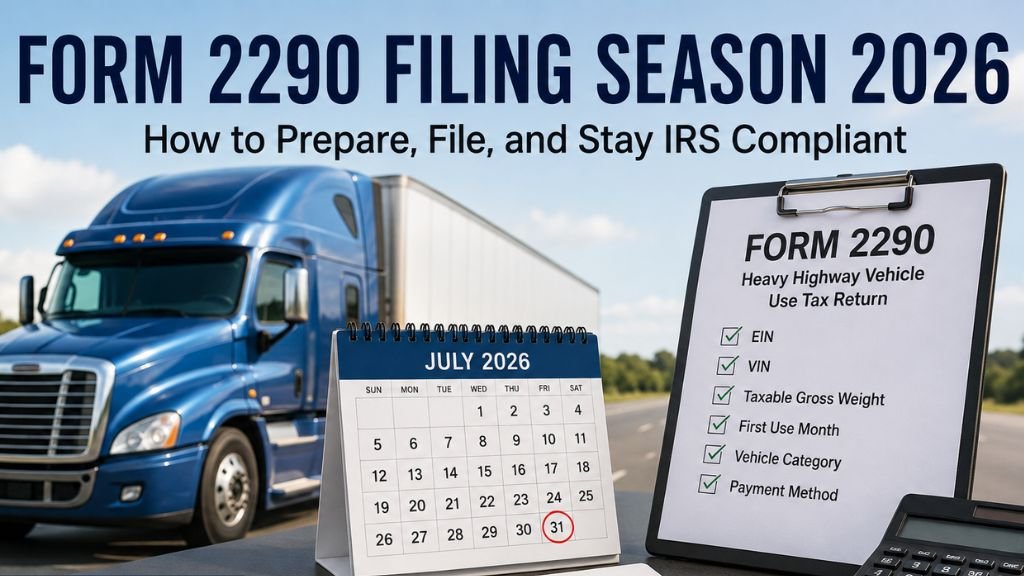
Table of Contents
Understanding the 2026 Form 2290 Filing Season
The Form 2290 Filing Season begins each year for heavy highway vehicles that are first used during the new tax period. The IRS requires eligible vehicle owners to report and pay the Heavy Highway Vehicle Use Tax using the current version of Form 2290. Before beginning your return, confirm that you are using:
- IRS Form 2290 (Rev. July 2026)
- Instructions for the 2026–2027 tax period
- The correct tax period beginning July 1, 2026
Using an outdated version of the form or filing for the wrong tax period can result in processing delays.
Determine Whether You Need to File Form 2290
Not every commercial vehicle requires Form 2290. The IRS generally requires filing when a highway motor vehicle:
- Is registered or required to be registered in your name under U.S., District of Columbia, Canadian, or Mexican law.
- Operates on public highways.
- Has a taxable gross weight of 55,000 pounds or more.
Vehicles commonly included are:
- Heavy trucks
- Truck tractors
- Buses
Certain vehicles may qualify for exemptions under IRS rules, including some government vehicles, qualified blood-collector vehicles, and qualifying specially designed mobile machinery.
Understanding Tax-Suspended Vehicles
Some vehicles are considered tax-suspended because they are expected to stay below the IRS mileage limit during the tax period.
Generally, this applies when the vehicle is expected to travel:
- 5,000 miles or less during the tax period.
- 7,500 miles or less for qualifying agricultural vehicles.
Although no tax may be due, these vehicles generally still need to be reported on Schedule 1 as Category W vehicles.
Understanding whether your vehicle is taxable or suspended is one of the first steps toward a successful Form 2290 Filing Season.
Gather Everything Before You Start Filing
Preparing your information before filing can help reduce mistakes and avoid unnecessary delays.
Verify Your EIN
The IRS requires an Employer Identification Number (EIN) for Form 2290. An SSN cannot be used in place of an EIN. If you recently applied for a new EIN, the IRS indicates it may take approximately four weeks before it becomes active in its systems for electronic filing.
Also verify that the business or owner name exactly matches the IRS records associated with that EIN.
Read More: Can I Use My SSN Instead of EIN for Filing Form 2290?
Confirm Every Vehicle’s VIN
Double-check the Vehicle Identification Number (VIN) before filing.
The VIN should match:
- Vehicle registration
- Vehicle title
- The vehicle itself
Do not use a trailer VIN when reporting a taxable highway vehicle.
Verify Vehicle Weight Information
The taxable gross weight determines the vehicle’s weight category for Form 2290. For most vehicles other than buses, taxable gross weight generally includes:
- The fully equipped, unloaded vehicle
- Trailers or semitrailers are customarily used with the vehicle
- The maximum customary load carried together
Depending on state registration practices, the registered or declared gross weight may affect the taxable weight category used for Form 2290.
Keep Supporting Documents Ready
Depending on your situation, you may also need documentation for:
- Logging vehicles
- Suspended vehicles
- Used vehicles
- Vehicle sales
- Vehicle theft or destruction
- Credit-eligible vehicles
Having these records available before the Form 2290 Filing Season begins can make the filing process more efficient.
Know Your Filing Deadline and First-Use Month
One of the most commonly misunderstood Form 2290 rules involves the month of first use. The IRS bases your filing deadline on the month the vehicle is first used on a public highway during the tax period, not on the vehicle registration or renewal date.
For example:
| First Used | File and Pay By | Enter on Line 1 |
|---|---|---|
| July 2026 | August 31, 2026 | 202607 |
| August 2026 | September 30, 2026 | 202608 |
| September 2026 | November 2, 2026 | 202609 |
| October 2026 | November 30, 2026 | 202610 |
| November 2026 | December 31, 2026 | 202611 |
| December 2026 | February 1, 2027 | 202612 |
If different vehicles are first used in different months, the IRS generally requires a separate Form 2290 for each first-use month. Keeping accurate first-use records is an important part of preparing for the Form 2290 Filing Season.
Review Your Tax Information Before Filing
Before submitting Form 2290, review every detail carefully.
Verify Your Vehicle Classification
Confirm:
- Taxable gross-weight category
- Logging vehicle status, if applicable
- Tax-suspended status, if applicable
- First-use month
- VIN
- Total vehicle count
Review Any Available Credits
Some vehicles may qualify for credits under IRS rules, such as those that were:
- Sold
- Destroyed
- Stolen
- Used within the applicable mileage limit
If you purchased a used vehicle through a private sale, retain documentation showing whether the previous owner paid the tax or reported the vehicle as suspended for the current tax period. A seller’s stamped Schedule 1 may help establish that the tax has already been reported.
Carefully reviewing these items before filing can help avoid amended returns and processing delays during the Form 2290 Filing Season.
Complete Your Form 2290 Filing Season Successfully
The IRS requires electronic filing for returns reporting and paying tax on 25 or more taxable vehicles. However, electronic filing is available for all eligible filers and is generally encouraged because an accepted return may produce an IRS-stamped Schedule 1 within minutes.
Tax-suspended Category W vehicles are not counted toward the IRS electronic filing threshold because no tax is being paid on those vehicles.
Available IRS payment methods include:
- Electronic Funds Withdrawal (EFW)
- Electronic Federal Tax Payment System (EFTPS)
- Credit or debit card
- Check or money order submitted with Form 2290-V
Paper filing remains available where permitted. If filing by mail, use the IRS mailing address that corresponds to your payment method. According to the IRS, paper filers generally receive a stamped Schedule 1 within several weeks after the return is received.
Keep Your Schedule 1 and Records
After filing, retain copies of:
- Form 2290
- IRS-stamped Schedule 1
- Payment confirmation or proof of mailing
- VIN records
- Weight documentation
- Supporting documents for suspended vehicles, logging vehicles, credits, sales, theft, or destruction
The IRS states that the stamped Schedule 1 serves as proof of filing and payment for state vehicle registration purposes unless an exemption applies. It may also be required by U.S. Customs and Border Protection when certain Canadian or Mexican vehicles enter the United States.
File Form 2290 Online with Truck2290
Preparing early for the Form 2290 Filing Season helps minimize filing errors and gives you time to verify your EIN, VIN, taxable gross weight, first-use month, and supporting records before submitting your return.
If you choose to file electronically, Truck2290 is an IRS-authorized Form 2290 e-file provider that allows eligible truck owners and fleet operators to submit Form 2290 online and receive an IRS-stamped Schedule 1 after the return is accepted by the IRS. Preparing your information before filing can help make the filing process faster and more accurate.
Note: Tax amounts and filing information referenced in this article are based on the 2026 IRS Form 2290 and publicly available IRS resources for the 2026–2027 tax period. Tax rates, filing requirements, forms, instructions, and deadlines may change in future tax years. Always refer to the latest IRS guidance before filing.