
Filing Form 2290 early can make Heavy Highway Vehicle Use Tax compliance easier to manage, particularly for truck owners and fleet operators who need an IRS-stamped Schedule 1 for vehicle registration. While the IRS does not establish a separate requirement to file Form 2290 “early,” submitting the return and paying the tax before the applicable deadline can provide more time to address filing errors, payment issues, or rejected returns.
For the 2026–27 tax period, Form 2290 covers heavy highway vehicles used from July 1, 2026, through June 30, 2027. If a taxable vehicle is first used on a public highway during July 2026, the Form 2290 return and tax payment are generally due by August 31, 2026.
The value of early filing is therefore mainly practical. When truck owners file Form 2290 early, they have more time between submitting the return and reaching the federal deadline.
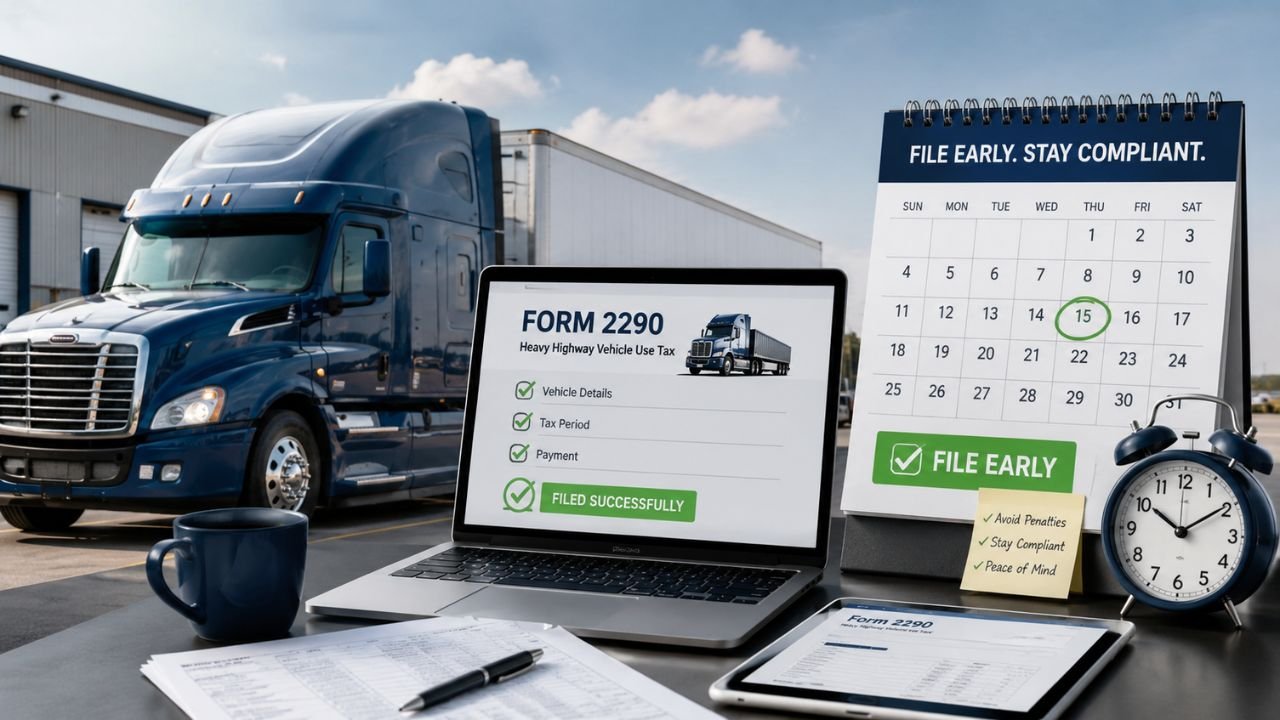
Table of Contents
What Does It Mean to File Form 2290 Early?
Form 2290 has an annual tax period, but the filing deadline for an individual vehicle depends on its first use during that period. The IRS generally requires the return to be filed by the last day of the month following the month in which the vehicle is first used on a public highway.
The 2026–27 tax period
The current Form 2290 tax period began July 1, 2026, and ends June 30, 2027. The filing period for this tax year also began July 1, 2026. For example, a taxable truck first used on a public highway in July 2026 generally has an August 31, 2026, Form 2290 filing and payment deadline.
This means filing Form 2290 early does not mean submitting a return before the IRS filing period begins. It means completing the applicable return during the filing period and before its actual due date.
Filing early does not change the deadline
Early filing does not move the tax period forward or change the taxpayer’s official due date. It simply creates additional time before that date.
This distinction is important because Form 2290 compliance is based on the vehicle’s first-use month rather than the date a truck is registered, purchased, or renewed with a state.
How Early Filing Can Reduce Last-Minute Filing Problems
Form 2290 contains information that must be accurate for the return to be processed correctly. A mistake discovered immediately before the deadline can create unnecessary pressure, particularly when several vehicles are included on the same return.
More time to check important vehicle information
A Form 2290 return generally includes information such as the taxpayer’s EIN, vehicle identification numbers, taxable gross-weight categories, and first-use details. The IRS requires an employer identification number for Form 2290. An individual’s Social Security number cannot be used instead of an EIN.
When truck owners file Form 2290 early, they have more time to review information before the filing deadline. This is particularly relevant for fleets where several VINs and vehicle categories must be reported.
Time to address rejected or incorrect returns
A return submitted electronically may require correction if information is incomplete or incorrect, or if the return is rejected during processing. Filing at the last moment leaves less time to deal with such issues.
Early submission provides a practical buffer for identifying a problem and resolving it before the deadline. It does not change IRS filing requirements, but it can reduce the pressure associated with a deadline-day filing.
Why Schedule 1 Is an Important Reason to File Early
Schedule 1 is closely connected to Form 2290 because it provides evidence that the Heavy Highway Vehicle Use Tax has been reported and paid. The IRS states that the stamped Schedule 1 is used as proof of payment when registering taxable vehicles, subject to applicable requirements.
Schedule 1 and vehicle registration
Truck owners may need the stamped Schedule 1 when registering a taxable heavy highway vehicle with a state. Because of this, the timing of Form 2290 filing can matter even when the federal filing deadline has not yet arrived.
For example, a truck owner who expects to need proof of payment for registration may benefit from completing the federal filing ahead of that registration-related need. The IRS also identifies Schedule 1 as proof of payment for certain Canadian and Mexican vehicles entering the United States.
Electronic filing and faster Schedule 1 availability
Electronic filing can be particularly useful when a taxpayer needs Schedule 1 promptly. According to the IRS, an electronically filed Form 2290 can result in a stamped Schedule 1 being available within minutes after IRS acceptance.
This is one of the practical reasons to file Form 2290 early rather than waiting until the final day. If a filing needs attention, there is more time to resolve the issue before the document is needed. Truck2290 is a Form 2290 filing platform that supports electronic Form 2290 filing and provides access to the accepted Schedule 1 after IRS processing.
How Early Filing Affects Penalties and Payment Timing
Filing early does not remove the Heavy Highway Vehicle Use Tax obligation. The return and payment still need to meet the applicable IRS deadline.
Filing and paying on time
The IRS requires Form 2290 to be filed and the related tax to be paid by the applicable due date. Late filing and late payment can result in penalties and interest.
Filing several days or weeks before the deadline gives taxpayers more time to deal with payment or processing issues. The benefit is the additional time available, not a reduction in the tax itself. For a July 2026 first-use vehicle, the applicable filing and payment deadline is August 31, 2026. Completing both before that date leaves additional time before the deadline.
An extension to the file does not extend the payment time
Another important distinction is that an extension of time to file does not extend the time for paying the tax. Therefore, waiting until the last possible moment can create two separate risks: a filing problem and a payment problem. Early submission gives more time to identify and address either issue.
Why Early Filing Matters More for Larger Fleets
The practical value of early filing can become more apparent as the number of vehicles increases. A fleet filing may involve numerous VINs, vehicle weights, first-use dates, and payment details.
Multiple vehicles require more information
Fleet operators may have to review information across many vehicles before submitting Form 2290. Even a small data-entry error can require additional attention. The IRS requires electronic filing for taxpayers reporting and paying tax on 25 or more vehicles, subject to the applicable rules. The IRS also encourages electronic filing for taxpayers with fewer vehicles because it generally allows faster processing.
For fleet operators, early filing creates additional time to review the return rather than concentrating all of the work around the deadline. The information that may require particular attention includes:
- EIN information for the taxpayer
- VINs for taxable vehicles
- Taxable gross-weight categories
- First-use information
- Payment details
- Schedule 1 information after IRS acceptance
Registration deadlines and tax deadlines are different
Form 2290 deadlines are determined by first use on a public highway, not simply by a vehicle’s state registration or renewal date. This distinction matters because a truck owner may have a registration requirement that occurs at a different time from the federal Form 2290 deadline.
Understanding the separate timelines makes it easier to see why filing Form 2290 early can be useful when Schedule 1 is expected to be needed for registration.
What Are the Main Benefits of Filing Form 2290 Early?
The IRS does not identify “early filing” as a separate compliance category. Instead, the benefits come from completing the required filing and payment before the applicable deadline.
More time before the deadline
The biggest practical benefit is the additional time available to deal with unexpected issues. A return filed well before the deadline leaves more room for corrections than a return submitted during the final hours. This can be particularly relevant when a fleet contains several vehicles or when the taxpayer needs Schedule 1 for registration.
Earlier access to proof of payment
When Form 2290 is electronically filed and accepted, the stamped Schedule 1 can generally become available quickly. Filing earlier can therefore reduce the possibility of needing the document immediately after a last-minute filing.
Less deadline pressure
Early filing also separates the tax compliance task from the pressure of the final deadline. Truck owners can complete the federal filing and payment before other operational or registration responsibilities become urgent.
For these reasons, choosing to file Form 2290 early is primarily a matter of timing and organization rather than a separate IRS requirement.
Conclusion
Form 2290 filing deadlines are based on when a heavy highway vehicle is first used on a public highway during the tax period. For the 2026–2027 tax period, the period runs from July 1, 2026, through June 30, 2027. A taxable vehicle first used in July 2026 generally has an August 31, 2026, filing and payment deadline.
The IRS does not require taxpayers to file before their applicable due date simply because they can. However, choosing to file Form 2290 early can provide practical advantages. It allows more time to review EIN and vehicle information, address rejected returns, resolve payment issues, and obtain the stamped Schedule 1 when it is needed as proof of payment for vehicle registration.
For electronic filing, platforms such as Truck2290 can facilitate Form 2290 submission and electronic access to Schedule 1 after IRS acceptance. The taxpayer remains responsible for providing accurate information and meeting the applicable IRS filing and payment requirements.
Data and pricing note: Any pricing information associated with Form 2290 filing services is based on publicly available 2026 information and may change over time. Form 2290 requirements, IRS procedures, and filing service features may also change. The information in this article is based on publicly available resources and should be checked against the latest IRS Form 2290 instructions before filing.