
Starting a trucking business in the United States involves several registrations, tax requirements, and transportation-related credentials. The process begins with setting up the business and obtaining an Employer Identification Number (EIN), followed by the registrations that apply to the type of trucking operation.
For businesses operating qualifying heavy highway vehicles, IRS Form 2290 is also an important federal tax filing. Understanding these requirements early can make it easier to keep business and vehicle records organized.
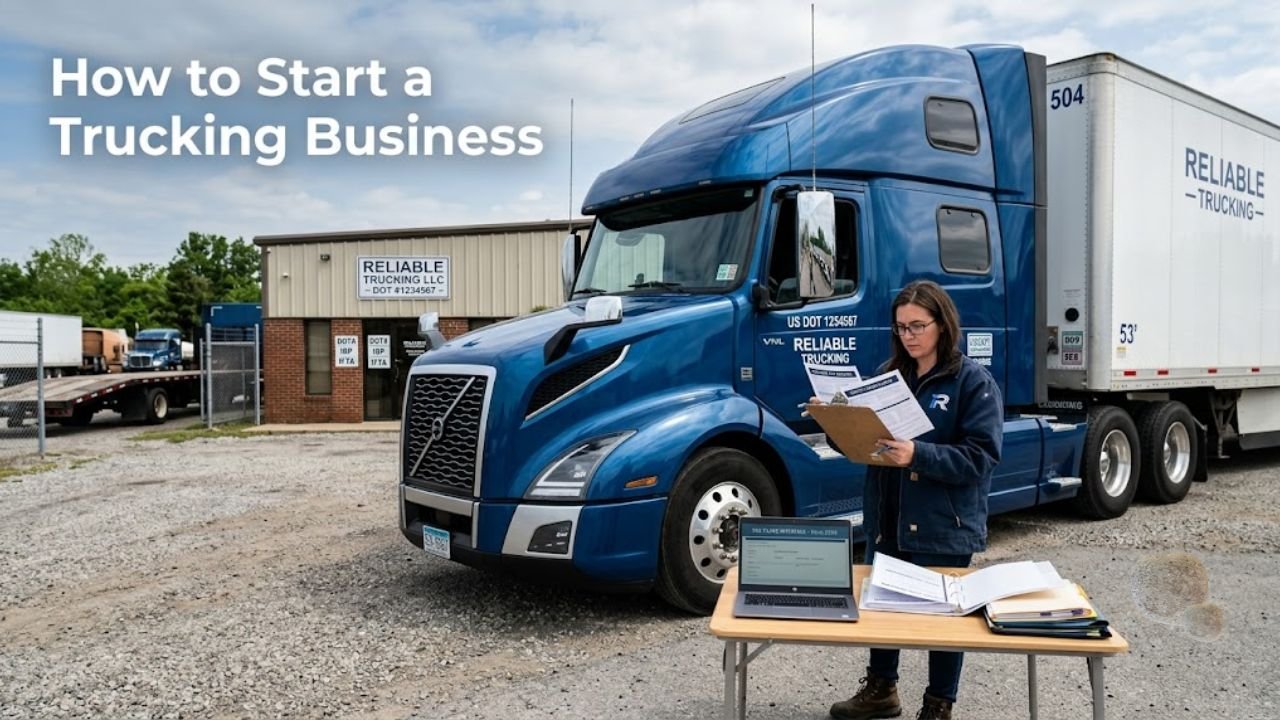
What Do You Need to Start a Trucking Business?
A trucking business may need several registrations and tax accounts depending on its business structure, vehicle, cargo, and operating area. Common requirements include:
- Business entity registration
- Employer Identification Number (EIN)
- USDOT Number
- Operating Authority, when applicable
- BOC-3 filing, when required
- Form 2290 for qualifying heavy highway vehicles
- State-specific registrations and permits
- IFTA and IRP requirements for qualifying interstate operations
- Unified Carrier Registration (UCR), when applicable
Not every trucking business needs every registration. Requirements depend on how the carrier operates and the type of transportation it provides.
Which Business Structure Is Used for a Trucking Business?
A trucking business can operate under different legal structures, including a sole proprietorship, limited liability company (LLC), or corporation.
A sole proprietorship is generally a simple business structure in which the owner and business are not separate legal entities. An LLC is a separate legal business entity under state law and can have different federal tax classifications. A corporation is another structure that may be used for a trucking company, with an eligible corporation potentially choosing S corporation tax treatment.
Business structure affects taxation, registration, and other compliance responsibilities. The structure itself does not determine whether a truck is subject to federal Heavy Highway Vehicle Use Tax.
Why Does a Trucking Business Need an EIN?
An Employer Identification Number (EIN) is a federal tax identification number issued by the IRS.
For Form 2290, an EIN is required. The IRS specifically states that a Social Security number cannot be used in place of an EIN for Form 2290. The name associated with the Form 2290 filing must also match the EIN records.
A trucking business should therefore have its EIN established before preparing Form 2290.
What Is a USDOT Number and When Is It Required?
A USDOT Number is a unique identifier used by the Federal Motor Carrier Safety Administration (FMCSA) to monitor a company’s safety information.
Companies operating commercial vehicles in interstate commerce may be required to register with FMCSA and obtain a USDOT Number. Certain intrastate hazardous-material carriers may also have USDOT requirements.
FMCSA registration requirements depend on the carrier’s operation, including factors such as the type of cargo and whether the operation is interstate or intrastate.
What Is Operating Authority or an MC Number?
A USDOT Number and operating authority are not the same thing.
FMCSA states that certain for-hire interstate motor carriers, brokers, and freight forwarders must have operating authority in addition to a USDOT Number. The specific authority depends on the company’s type of operation.
Therefore, a trucking business should determine its FMCSA classification before assuming that it needs a particular type of authority.
What Is a BOC-3 Filing?
A BOC-3 filing identifies process agents who can receive legal documents on behalf of a motor carrier, broker, or freight forwarder.
FMCSA maintains information about process agents and explains the requirements associated with process-agent designations.
The BOC-3 requirement depends on the type of transportation operation and applicable FMCSA rules.
What Is Form 2290 for Trucking Businesses?
Form 2290, Heavy Highway Vehicle Use Tax Return, is used to report and pay federal Heavy Highway Vehicle Use Tax.
For the July 1, 2026, through June 30, 2027 tax period, a taxable highway motor vehicle generally falls under Form 2290 when it has a taxable gross weight of 55,000 pounds or more and is registered, or required to be registered, in the owner’s name at the time of first use.
The tax applies to qualifying vehicles used on public highways. Trucks, truck tractors, and buses can fall within the definition of a highway motor vehicle when they meet the applicable requirements.
When Is Form 2290 Due?
Form 2290 is based on the month the vehicle is first used on a public highway, not the vehicle’s registration renewal date.
For the 2026–2027 tax period, the IRS states that the return is generally due by the last day of the month following the month of first use. For example, a qualifying vehicle first used in July 2026 generally has a filing deadline of August 31, 2026.
The IRS uses a prorated tax calculation when a qualifying vehicle is first used after July.
What Information Is Needed to File Form 2290?
Before preparing Form 2290, truck owners should have the required vehicle and taxpayer information available.
The IRS identifies the following key information:
- Employer Identification Number (EIN)
- Vehicle Identification Number (VIN)
- Taxable gross weight
- Month of first use
- Vehicle information for Schedule 1
The VIN should correspond to the vehicle being reported, rather than its trailer.
What Is Schedule 1 of Form 2290?
Schedule 1 is an important part of the Form 2290 filing. It reports the vehicles included in the return and their VINs.
The IRS-stamped Schedule 1 can serve as proof of payment for vehicle registration when applicable. When Form 2290 is filed electronically and accepted, an IRS-watermarked Schedule 1 can generally become available electronically within minutes.
For returns reporting and paying tax on 25 or more vehicles, electronic filing is required. The IRS also encourages electronic filing for smaller filings.
What Other Trucking Taxes and Registrations May Apply?
Form 2290 is only one federal requirement that may apply to a trucking operation.
Depending on the business and its operations, a carrier may also encounter requirements involving:
- IFTA: Fuel tax reporting for qualifying motor vehicles operating in multiple jurisdictions.
- IRP: Apportioned registration for qualifying vehicles operating across jurisdictions.
- UCR: Annual registration requirements for certain interstate carriers and other covered entities.
- State permits and registrations: Individual states may impose additional requirements.
These requirements are separate from the federal Heavy Highway Vehicle Use Tax and have their own eligibility rules and filing schedules.
How Does Truck2290 Help With Form 2290 Filing?
Truck2290 is an IRS-authorized Form 2290 e-file provider. Truck owners can use an authorized e-file provider to electronically submit Form 2290 and receive the IRS Schedule 1 after the return is accepted.
For businesses operating heavy highway vehicles, keeping the EIN, VIN, taxable gross weight, first-use month, and filing records organized can make recurring Form 2290 reporting easier.
Starting a trucking business involves several layers of registration and compliance. Understanding the difference between business registration, FMCSA requirements, and federal vehicle taxes helps truck owners identify which requirements apply to their particular operation.