
If your heavy vehicle is expected to travel only a limited number of miles during the tax year, you may be eligible for a Form 2290 5000-mile suspension. This provision allows qualifying vehicle owners to file Form 2290 without paying Heavy Vehicle Use Tax (HVUT), provided certain IRS requirements are met.
Many truck owners mistakenly believe that a suspended vehicle does not need to be reported. However, the IRS still requires eligible vehicles to be listed on Form 2290, even when no tax is due.
This guide explains who qualifies, how to claim the suspension, and what happens if the mileage limit is exceeded during the tax period.
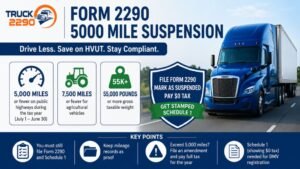
What Is the Form 2290 5000 Mile Suspension?
The Form 2290 suspension applies to taxable highway motor vehicles that are expected to travel 5,000 miles or fewer on public highways during the tax year, which runs from July 1 through June 30.
For qualifying vehicles, the HVUT is suspended, meaning no tax payment is required at the time of filing. However, owners must still submit Form 2290 and report the vehicle as suspended.
Mileage Limits for Suspension
| Vehicle Type | Mileage Threshold |
|---|---|
| Standard taxable vehicles | 5,000 miles or fewer |
| Agricultural vehicles | 7,500 miles or fewer |
The suspension is based on a reasonable expectation that the vehicle will remain below the applicable mileage limit during the tax year.
Who Qualifies for a Form 2290 Suspension?
A vehicle may qualify for suspension if it meets all of the following conditions:
| Requirement | Details |
|---|---|
| Vehicle weight | 55,000 pounds or more gross taxable weight |
| Expected mileage | 5,000 miles or fewer during the tax year |
| Agricultural vehicles | 7,500 miles or fewer |
| Good-faith expectation | The owner reasonably expects the vehicle to stay under the mileage limit |
| Form filing | Form 2290 must still be filed with the IRS |
The IRS expects filers to make this determination in good faith based on planned vehicle usage.
How to Claim the Form 2290 5000 Mile Suspension
Claiming the suspension is generally straightforward.
Step 1: File Form 2290
Even if no tax is owed, you must file Form 2290 for the vehicle.
Step 2: Report the Vehicle as Suspended
In Part II of Form 2290, identify the vehicle as a suspended vehicle because you expect it to remain under the mileage threshold.
Step 3: Submit Schedule 1
After the return is processed, the IRS issues a stamped Schedule 1 showing that the vehicle was reported and that no HVUT payment was due.
Step 4: Retain Supporting Records
Keep documentation that supports the vehicle’s mileage, such as:
- Mileage logs
- Trip sheets
- Dispatch records
- GPS tracking reports
- Maintenance records showing odometer readings
These records may help demonstrate compliance if questions arise later.
Why Is Schedule 1 Important?
Many state motor vehicle agencies require a valid Schedule 1 before registering or renewing registration for a heavy vehicle.
Even when tax is suspended, the Schedule 1 serves as proof that Form 2290 was properly filed.
A Schedule 1 showing zero tax due is generally acceptable for registration purposes when the vehicle qualifies for suspension.
What Happens If You Exceed 5,000 Miles?
A vehicle can lose its suspended status if it exceeds the mileage limit during the tax year.
If that happens, additional filing obligations may apply.
When Mileage Exceeds the Limit
If a vehicle that was reported as suspended later exceeds:
- 5,000 miles (standard vehicle), or
- 7,500 miles (agricultural vehicle),
the owner generally must file a Form 2290 amendment and pay the applicable HVUT for that vehicle.
Tax Is Not Prorated
When a suspended vehicle exceeds the mileage threshold, the tax generally becomes due for the entire tax period rather than being calculated only on the excess miles driven.
Because filing requirements can vary based on specific circumstances, vehicle owners should review current IRS instructions when reporting mileage changes.
Common Misunderstandings About Suspended Vehicles
Many Form 2290 filing mistakes happen because vehicle owners misunderstand how the suspension rules work. A suspended vehicle is still subject to IRS reporting requirements, even when no tax payment is due. Understanding these common misconceptions can help you stay compliant and avoid unexpected tax obligations later in the tax year.
Suspension Does Not Mean Registration Is Suspended
The term “suspended” refers only to the suspension of HVUT liability. It does not mean the vehicle’s registration or operating authority is suspended.
Total Mileage Counts
The mileage calculation generally includes total public highway mileage accumulated during the tax period, regardless of changes in ownership.
New Vehicles May Qualify
A newly purchased vehicle may be reported as suspended if the owner reasonably expects it to remain below the applicable mileage limit during the tax year.
Benefits of Filing a Suspended Vehicle Correctly
Properly reporting suspended vehicles can help:
- Avoid unnecessary HVUT payments
- Obtain a valid Schedule 1 for registration purposes
- Maintain compliance with IRS filing requirements
- Create a documented record of low-mileage vehicle use
Accurate reporting and recordkeeping are important throughout the tax year.
Final Thoughts
The Form 2290 5000-mile suspension can be a valuable option for owners of low-mileage heavy vehicles. If you reasonably expect a vehicle to travel 5,000 miles or fewer during the tax year—or 7,500 miles or fewer for agricultural vehicles—you may qualify to report the vehicle as suspended and owe no HVUT at the time of filing.
However, filing Form 2290 is still required. Vehicle owners should also maintain mileage records and monitor usage throughout the year. If the vehicle exceeds the mileage limit, additional reporting and tax obligations may apply.
Using an IRS-authorized e-file provider such as Truck2290 can help simplify Form 2290 filing and ensure that suspended vehicles are reported correctly according to current IRS requirements.
FAQs
What is a suspended vehicle on Form 2290?
A suspended vehicle is a taxable heavy vehicle that is expected to travel no more than 5,000 miles during the tax year, or 7,500 miles for agricultural vehicles. Although no HVUT is due initially, the vehicle must still be reported on Form 2290.
Do I need to file Form 2290 if I drive under 5000 miles?
Yes. Qualifying vehicles must still be reported on Form 2290 and listed as suspended vehicles, even when no tax payment is required.
How do I claim the 5000-mile suspension on Form 2290?
File Form 2290, identify the vehicle as suspended in the appropriate section of the return, and submit the filing to receive a Schedule 1 showing no tax due.
What happens if I exceed 5000 miles on a suspended vehicle?
If the vehicle exceeds the mileage threshold during the tax year, you may need to file an amendment and pay the applicable Heavy Vehicle Use Tax.
What is the Form 2290 agricultural vehicle 7500 miles exemption?
Agricultural vehicles may qualify for suspension when they are expected to travel 7,500 miles or fewer on public highways during the tax year.
What records should I keep for a suspended vehicle?
Vehicle owners should maintain mileage documentation such as trip logs, GPS reports, dispatch records, and odometer readings to support the vehicle’s suspended status.