

2290 Online Ohio: File Form 2290 for Heavy Vehicles in Ohio
File Form 2290 online for your Ohio heavy vehicle with Truck2290.
As an IRS-authorized Form 2290 e-file provider, Truck2290 helps owner-operators and fleets complete their HVUT filing, receive an IRS-stamped Schedule 1 after IRS acceptance, and securely store filing records.
What Is a 2290 Online Filing, and Why Does Ohio Require It
Form 2290 is the federal Heavy Vehicle Use Tax (HVUT) return filed with the IRS each tax year for taxable highway vehicles weighing 55,000 pounds or more. The HVUT tax period runs from 1 July through 30 June.
Although Ohio does not collect this federal tax, the Ohio BMV generally requires an IRS-stamped Schedule 1 before renewing the registration of qualifying heavy vehicles. This document serves as proof that the federal filing requirement has been completed.
- Tractor-trailers
- Box trucks
- Dump trucks
- Flatbed trucks
- Refrigerated trucks
- Tow trucks
- Concrete mixers
- Commercial buses
- Hotshot trucks (that meet the taxable weight requirement)
Filing Form 2290 Online for Ohio Truck Owners
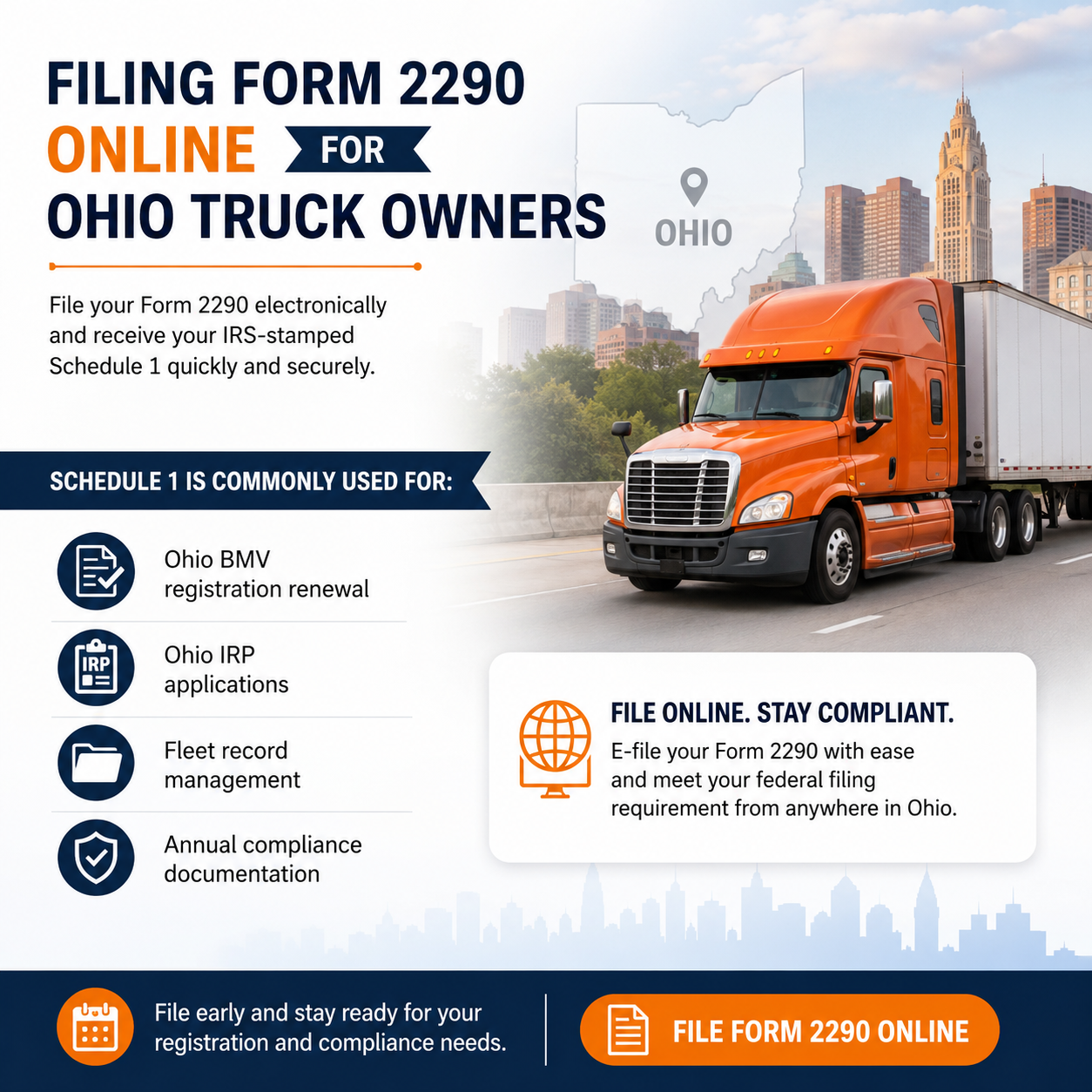
For many commercial vehicle owners, Form 2290 is one of several annual compliance requirements. Filing electronically allows Ohio truck owners to submit their federal tax return directly to the IRS and receive an IRS-stamped Schedule 1 after acceptance
Schedule 1 is often used when preparing for:
- Ohio BMV registration renewal
- Ohio IRP applications
- Fleet record management
- Annual compliance documentation
Whether your business operates in Columbus, Cleveland, Cincinnati, Toledo, Akron, Dayton, Canton, Youngstown, or elsewhere in Ohio, electronic filing provides a convenient way to complete the federal filing requirement.
If your registration deadline is approaching, filing Tax 2290 Texas online can help you prepare your required documents sooner
Ohio Registration Requirement for Heavy Vehicles
The Ohio Bureau of Motor Vehicles generally requires a current IRS-stamped Schedule 1 before renewing the registration of qualifying heavy highway vehicles.
There is also an important ownership provision to understand.
If a vehicle has been owned for less than 60 days, the initial registration may not require a Schedule 1 in certain situations. Once ownership exceeds 60 days, the IRS-stamped Schedule 1 is generally required during future registration transactions.
Keeping your Form 2290 filing completed before renewal helps ensure you have one of the documents commonly requested during the registration process.
Ohio IRP Registration & Form 2290 Requirements
Understand the documents required for Ohio IRP registration, owner-operator situations, and important IRS Form 2290 filing deadlines.
Ohio IRP Registration Documents
For interstate carriers, Form 2290 is one part of the Ohio International Registration Plan (IRP) application.
- Front & Back copies of the Vehicle Title
- BMV 4885 (Motor Carrier Responsible for Safety Statement) or eligible Lease Agreement
- IRS-Stamped Form 2290 Schedule 1 (Vehicles owned more than 60 days)
- PUC 3422 (HAZMAT Declaration of Knowledge), if applicable
- BMV 4856 (Establishing Base Jurisdiction) for first-time IRP applicants
Leasing & Owner-Operator Requirements
If the titled owner differs from the IRP registrant, Ohio may request additional supporting documentation.
- Power of Attorney
- BMV 4845
- Titled Owner’s Taxpayer Identification Number (TIN)
- Titled Owner’s Address
These documents are submitted with the required registration paperwork, including the IRS-stamped Schedule 1 where applicable.
Form 2290 Filing Deadlines
The federal Heavy Vehicle Use Tax follows the annual tax period
Important filing deadlines include:
- Vehicles first used in July: File by 31 August
- Vehicles first used in other months: File by the last day of the month following the month of first use
Form 2290 Filing Deadlines for Ohio
The federal Heavy Vehicle Use Tax follows the annual tax period:
1 July – 30 June
Important filing deadlines include:
-
Vehicles first used in July: File by 31 August
-
Vehicles first used in other months: File by the last day of the month following the month of first use
Late filing may result in IRS penalties, interest, and delays in obtaining a current Schedule 1 if it is needed for registration or IRP documentation.
Preparing for the New Tax Year 2026
Many Ohio trucking businesses prepare their Form 2290 information before the IRS opens the new filing season.
Preparing early allows you to organise:
- Employer Identification Number (EIN)
- Business information
- Vehicle Identification Numbers (VINs)
- Taxable gross weight
- First-used month for each vehicle
Having this information ready can simplify filing when the new tax period begins.
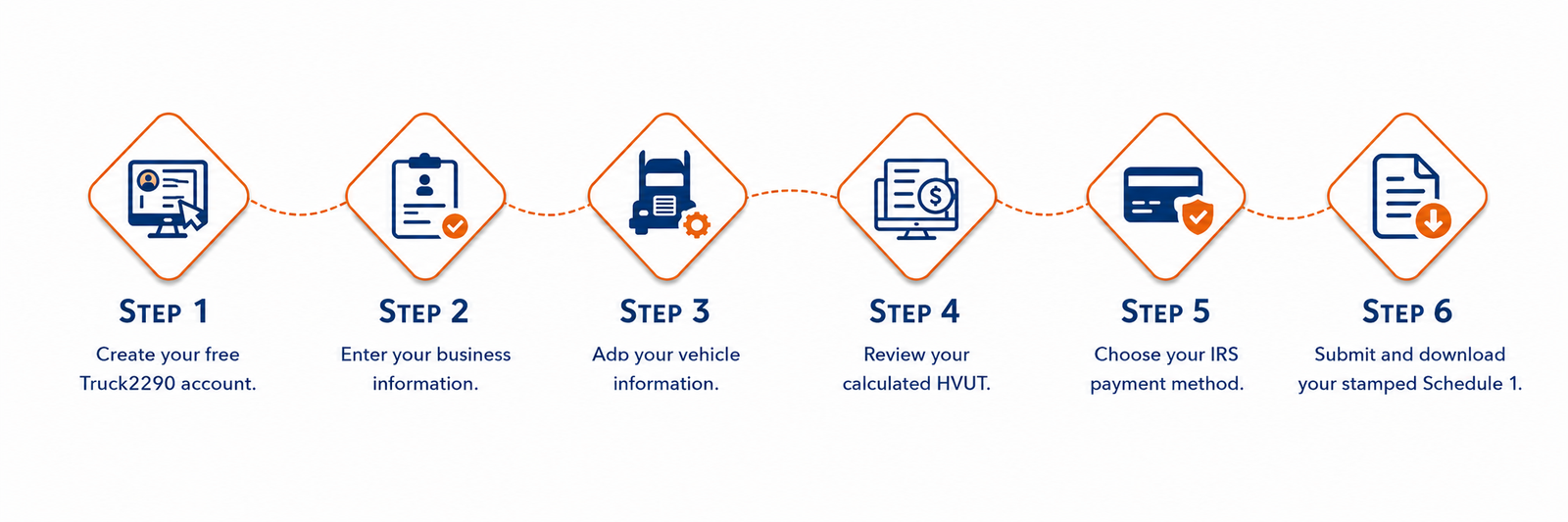
File Tax 2290 Texas Online in Six Simple Steps 2290 Road Tax?
Truck2290 makes the filing process straightforward, even if you’re filing for the first time.
Step 1:
Create your free Truck2290 account.
Step 2:
Enter your EIN and legal business information.
Step 3:
Add each vehicle’s VIN, taxable gross weight, and first-used month.
Step 4:
Review the automatically calculated Heavy Vehicle Use Tax.
Step 5:
Choose an IRS payment option, including EFW, EFTPS, credit/debit card, or cheque/money order
Step 6:
Submit your return electronically. After IRS acceptance, download your IRS-stamped Schedule 1 for your records and Ohio registration requirements.

Why Choose Truck2290 for Ohio Form 2290 Filing?
Truck2290 is an IRS-authorized Form 2290 e-file provider designed for owner-operators, trucking businesses, and commercial fleets.
Features
- IRS-authorized electronic filing
- Automatic HVUT tax calculation
- IRS-stamped Schedule 1 after IRS acceptance
- Free VIN Correction
- Bulk VIN Upload for fleet operators
- Secure online storage for previous filings
- Support for single trucks and large fleets
- Single vehicle filing starts at $7.99
Frequently Asked Questions
Does Ohio require Form 2290?
Form 2290 is a federal IRS filing requirement. The Ohio BMV generally requires the resulting IRS-stamped Schedule 1 for qualifying heavy vehicle registration renewals.
Does Ohio BMV accept an electronically filed Schedule 1?
Yes. An IRS-stamped Schedule 1 received after electronic filing is accepted when Schedule 1 is required.
What documents are needed for an Ohio IRP application?
Depending on your circumstances, the application may require vehicle title copies, BMV forms, lease documents, HAZMAT declarations where applicable, and an IRS-stamped Schedule 1.
What if I bought my truck less than 60 days ago?
Vehicles owned for fewer than 60 days may qualify for the ownership exception during initial registration. Future renewals generally require a current Schedule 1.
Can owner-operators have additional documentation requirements?
Yes. When the titled owner and IRP registrant differ, Ohio may require a Power of Attorney or BMV 4845 with other supporting documents.
File Form 2290 Online for Ohio
Completing your 2290 Online Ohio filing helps satisfy the federal Heavy Vehicle Use Tax requirement and provides the IRS-stamped Schedule 1 commonly needed for Ohio heavy vehicle registration and IRP documentation.
Truck2290 is an IRS-authorized Form 2290 e-file provider that enables Ohio truck owners and fleets to file electronically, manage previous filings, and download their IRS-stamped Schedule 1 after IRS acceptance.
ˇ