

File Your HVUT 2290 Today and Get Your Schedule 1 Before the Deadline
Every day without a stamped Schedule 1 is a day your truck cannot be legally registered. Filing takes minutes. Getting caught without it costs far more
IRS-authorized e-file provider. Schedule 1 returned the same day. No paper. No delays.
What Is HVUT and How Does Form 2290 Connect to It?
HVUT stands for Heavy Vehicle Use Tax. It is a federal excise tax charged on heavy motor vehicles that operate on public highways in the United States.
If your truck has a gross vehicle weight of 55,000 pounds or more and runs on public roads, this tax applies to you.
What is Form 2290
Form 2290 is the IRS form you use to report and pay that tax. You cannot skip it and you cannot delay it without paying a price. When your 2290 is filed and accepted, the IRS returns a stamped Schedule 1 to you. That document is your proof of payment. Without it, your state DMV will not process your vehicle registration.
Tax Year
July 1 – June 30
Standard Deadline
August 31
Late First Use?
File by the last day of the following month
Filing through an IRS-authorized e-file provider means your return goes directly to the IRS and your Schedule 1 comes back the same day. Get Schedule 1 fast.
Why Form 2290 Matters
All you need to get started
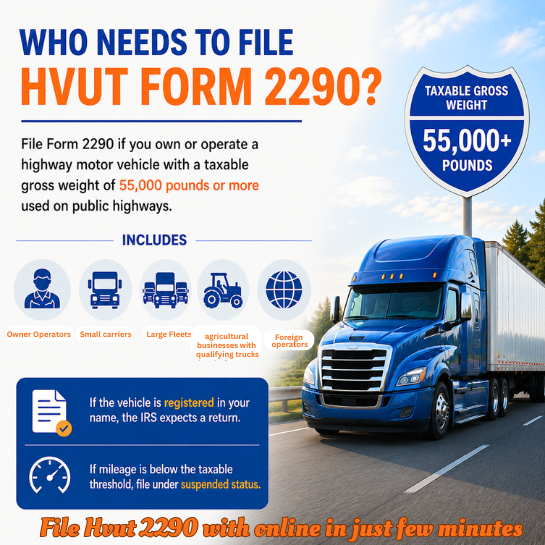
Who Needs to File HVUT Form 2290?
You must file Form 2290 if you own or operate a highway motor vehicle with a taxable gross weight of 55,000 pounds or more and that vehicle is used on public highways during the tax period.
This covers a wide range of filers. Owner-operators running a single truck, small carriers managing a handful of vehicles, large fleets with dozens of units, agricultural businesses with qualifying trucks, and any individual or company with a heavy vehicle registered in their name all fall under this requirement. Foreign operators using U.S. highways are subject to HVUT as well.
If the vehicle is registered or required to be registered in your name, the IRS expects a return. Even if you believe your mileage will stay below the taxable threshold, you still need to file and report the vehicle under suspended status.
HVUT 2290 Tax Rates by Vehicle Weight
Your tax amount depends on the gross vehicle weight category of your truck and the number of months it will be in use during the tax year. Below are the standard annual rates for the full tax period.
Taxable Gross Weight: 55,000 to 75,000 pounds
Taxable Gross Weight: Over 75,000 pounds
The maximum annual HVUT rate is $550. Any vehicle with a taxable gross weight above 75,000 pounds falls into this category.
Logging Vehicles
Trucks used exclusively to transport harvested forest products are taxed at half the standard rate for their weight category.
Suspended Vehicles
Vehicles expected to travel 5,000 miles or fewer during the tax year (7,500 miles or fewer for agricultural vehicles) are reported under suspended status. No payment is due at filing time. If the vehicle later exceeds that mileage limit, an amended return with full tax payment is required.
For mid-year vehicle purchases, your tax is prorated based on the number of months remaining in the tax year starting from your first use month. You only pay for the months your truck is on the road.
| Taxable Gross Weight | HVUT Amount |
|---|---|
| 55,000 to 56,000 pounds | $100 |
| 57,000 pounds | $122 |
| 58,000 pounds | $144 |
| 59,000 pounds | $166 |
| 60,000 pounds | $188 |
| 61,000 pounds | $210 |
| 62,000 pounds | $232 |
| 63,000 pounds | $254 |
| 64,000 pounds | $276 |
| 65,000 pounds | $298 |
| 66,000 pounds | $320 |
| 67,000 pounds | $342 |
| 68,000 pounds | $386 |
| 70,000 pounds | $408 |
| 71,000 pounds | $430 |
| 72,000 pounds | $452 |
| 73,000 pounds | $474 |
| 74,000 pounds | $496 |
| 75,000 pounds | $518 |
Suspended Vehicles and HVUT Exemptions
Not every qualifying vehicle triggers a payment. Two categories receive special treatment under HVUT rules.
A suspended vehicle is one you expect to drive 5,000 miles or fewer during the tax period. Agricultural vehicles have a higher threshold of 7,500 miles. You still file Form 2290 for these vehicles. You report them, claim the suspension, and submit the return. No payment is due unless that mileage limit is crossed later in the year.
Exempt vehicles include those owned by federal, state, and local governments, vehicles operated by qualified blood collector organizations, and certain vehicles owned by American Indian tribal governments. If your vehicle falls into an exempt category, it is not subject to HVUT regardless of weight or mileage.
If you are unsure whether your truck qualifies as suspended or exempt, do not guess. Filing incorrectly and overpaying is a common and avoidable mistake.
Not sure if your vehicle qualifies as suspended? Our team reviews your details before you file. No guesswork. No overpayment.
Your Stamped Schedule 1 and Why It Cannot Wait
When the IRS accepts your Form 2290, it returns a stamped Schedule 1 to you. This is your official proof that HVUT has been reported and paid for that vehicle.
Every state DMV in the country requires this document to process registration for heavy trucks. No Schedule 1 means no registration. No registration means your truck is not road-legal. For owner-operators and fleets, that is lost revenue, not just a paperwork problem.
When you e-file through an IRS-authorized provider, your Schedule 1 arrives digitally with the official IRS stamp already applied. You can print it immediately and take it to registration the same day.
Paper filers wait weeks for their stamped Schedule 1 to arrive by mail. E-filers receive it within hours or the same day in most cases. For anyone running on a deadline, that difference matters.
Your Schedule 1 comes back with the official IRS digital stamp. Accepted by all state DMVs for vehicle registration.
Just Bought a Truck? File HVUT 2290 for Your New Vehicle Now.
Purchasing a truck mid-year does not mean you wait until July to file. HVUT uses a first-use month rule. The month you first drive that vehicle on a public highway is the month that starts your filing clock.
Your deadline is the last day of the month following your first use month. Put a truck on the road in September and your 2290 is due by October 31. Miss that date and penalties begin.
Your tax is prorated for the months remaining in the tax year. You are not paying a full year of HVUT for a truck that has only been in service for part of the year. The IRS calculates the tax based on how many months are left from your first use month through June 30.
The filing process for a mid-year purchase is identical to the standard July filing. You enter your EIN, your VIN, select your first use month, confirm your weight category, and submit. Your stamped Schedule 1 comes back the same day.
Bought a truck mid-year? We handle first-use month filings every day. File in minutes. Stay road-legal.

VIN Corrections and Amended Returns
VIN correction
The first is a VIN correction. If you entered your Vehicle Identification Number incorrectly on the original return, you need to file a corrected return. The IRS allows one free VIN correction per vehicle. Through e-file, this takes only a few minutes and your corrected Schedule 1 is returned promptly.
Amended Returns
If you originally filed under suspended status because you expected to stay under 5,000 miles (or 7,500 for agricultural vehicles) and your truck later crossed that threshold, you are required to file an amended return and pay the tax for the remainder of the year. This must be done by the last day of the month following the month when the mileage limit was exceeded.
How to File HVUT Form 2290 Online in Minutes
Paper filing used to mean printing forms, mailing checks, and waiting three to six weeks for a stamped Schedule 1 to come back. E-filing changed that completely. Today, most filers get their Schedule 1 back the same day.
Here is how the process works from start to finish.
Step 1: Enter your business information
You will need your Employer Identification Number. The IRS does not accept Social Security Numbers for Form 2290 filings. If you do not have an EIN, apply through the IRS website. Online applications are processed immediately.
Step 2: Enter your vehicle details
Provide your Vehicle Identification Number, your taxable gross weight category, and your first use month for each vehicle you are reporting.
Step 3: Review your tax calculation
Your filing platform calculates the tax owed based on your weight category and first use month. Review the figures before submitting.
Step 4: Submit and pay
Submit your return electronically. Your HVUT payment goes directly to the IRS through an approved payment method.
Step 5: Receive your stamped Schedule 1
Once the IRS accepts your return, your stamped Schedule 1 is sent to you digitally. Print it and use it for registration the same day.
The entire process takes most filers under ten minutes.
Frequently Asked Questions
Everything you need to know about IRS Form 2290 and Heavy Vehicle Use Tax filing.
What if I have multiple trucks?
You report all qualifying vehicles on a single Form 2290 return, organized by weight category and first-use month. There is no need to file a separate return for each truck.
Can I file Form 2290 without an EIN?
No. An Employer Identification Number (EIN) is required for all 2290 filings. The IRS does not accept Social Security Numbers in its place. Apply for your EIN through the IRS website. Online applications are typically issued immediately.
What happens if I file my heavy vehicle use tax return late?
Late filing results in penalties and interest. The IRS charges a penalty of 4.5% of the total tax due, applied monthly for up to five months. Additional penalties may apply to unpaid tax balances.
What if I have both suspended and taxable vehicles?
You can report both on the same Form 2290 return. Taxable vehicles are reported with the tax owed, while suspended vehicles are reported separately with no payment due.
Do I need to file if my truck is not currently in use?
If the vehicle is registered in your name or required to be registered, the IRS generally expects a return. You may qualify for suspended status if the vehicle remains below the mileage threshold during the tax year.
What is the difference between IRS 2290 online filing and paper filing?
Online filing through an IRS-authorized e-file provider typically returns your stamped Schedule 1 the same day. Paper filing can take three to six weeks and may delay vehicle registration.
File Your HVUT 2290 Now and Keep Your Trucks Moving
Every unpaid HVUT bill and every missed filing deadline creates a problem that costs more to fix than it would have cost to file on time. Penalties add up fast. A truck that cannot be registered is a truck that is not earning.
Filing online takes under ten minutes. Your Schedule 1 comes back the same day. Your trucks stay road-legal and your records stay clean.
Do not wait until the deadline is tomorrow. File today and move on.